[Sermon Analyst]Log in

What has your congregation been hearing?

Sermon Analyst listens to years of sermons from your church’s podcast feed or YouTube channel: the themes you return to, the Scripture you’ve covered, the ground you haven’t touched.

A review of each Sunday’s message in your inbox every week, set against that larger picture. A look back across the season when it’s time to plan the next.

Preaching teams & elders
Give your elders and your pastoral team something concrete to talk about.
Leadership transitions
New teaching pastor? Hand them a preaching retrospective to get them up to speed.

Sermon Analyst won’t write your sermons or grade your theology.

It doesn’t learn from your questions, and never trains on your data.

How we think about AI →

In your inbox

A review of Sunday's sermon, every week.

What a listener most likely walked out with, how it fits the last few months, and how it relates to what you set out to preach this season. Sent automatically.

What Came Through

The three-question framework gave the sermon a clear skeleton, and Jacob moved through it with genuine pastoral warmth. The observation that every human institution surrounding the crucifixion — government, religion, family, friendship — failed Jesus was one of the sermon's more striking structural moments, and the closing corporate confession was a strong pastoral move: it crystallized both the human-brokenness and the extravagant-love strands of the sermon into a single participatory moment.

Recent Trajectory

This sermon marks the first time in the Mark series, and arguably in the recent window as a whole, that suffering has been named as a primary category of Christian experience rather than a backdrop. That is new ground: suffering is significantly underrepresented in the broader corpus (roughly 6% of sermons across 46 messages).

Goals Review

This sermon's strongest contribution is to the discipleship aim. Service, however, has largely receded since the "Sending Sunday" message on July 26. Whether that gap is a deliberate sequencing decision or the natural focus of a passion narrative is a judgment for the preaching team, but service as a goal has had little direct reinforcement over the past five weeks.

Retrospective reports

Years of preaching, summarized.

The themes you return to, the Scripture you've covered, the ground you haven't touched. Something concrete for your elders and your teaching team to talk about.

Five years of preaching have circled around a small, durable cluster of convictions: that God pursues broken people with greater persistence than they flee; that the church is called outward as much as it is gathered inward; that forgiveness is not a secondary Christian virtue but the central one; and that the spiritual life is meant to touch and transform ordinary daily existence rather than exist alongside it. Luke 15, Romans 3-8, Matthew 5-7, Isaiah 53, and Ephesians 2 have carried most of this teaching, alongside a sustained engagement with the Old Testament that has taken Israel's wilderness wandering, its covenant history, and its patriarchal narratives seriously as the congregation's own story. The thread from Abraham through Paul through the present congregation — "for what I received, I passed on to you" — runs underneath nearly everything. These have been years of a community learning, repeatedly and from multiple angles, to understand what it has already been given.

Preaching review

Plan your next preaching season.

Themes, gaps, and Scripture coverage from the last year as you plan the next, and a check-in against what you set out to preach.

Executive Summary

  • Jesus and discipleship dominate the focus period, with striking coherence around the church's stated mission. The two most frequent themes — Jesus & the Gospel (30 sermons) and Obedience & Discipleship (28 sermons) — together appear in roughly three-quarters of all preaching.
  • Romans and Matthew are by far the most preached books, with Genesis and John also well-represented; the Pauline epistles anchor much of the theological scaffolding.
  • Grace and the law receive sustained, sophisticated treatment — a clear signal of the Lutheran theological tradition. Martin Luther is the most cited external voice, and the three uses of the law, justification by faith, and the Five Solas each received dedicated sermon attention.
  • Two themes that received significant attention in the prior period have receded sharply: Church Life & Community dropped from 22 sermons to 3, and Hope & Encouragement from 9 to 2. The theological center of gravity has shifted inward — from community formation to personal transformation.
  • Parenting emerged as a notable new emphasis (5 sermons, absent from prior preaching), clustered in the "A Day in the Life" and "Reformatio" series. This likely reflects the congregation's family composition and the church's investment in multi-generational faith formation.

Draft feedback

Feedback on a draft, before anyone hears it.

Paste what you have so far. See how it reads against everything you've already preached.

Sermon Effectiveness

This sermon does several things well. The opening is immediately disarming — the story of Mary and Joseph losing Jesus for three days is genuinely funny, sets the series premise efficiently, and accomplishes something difficult: it gives anxious parents permission to feel inadequate without wallowing in that feeling.

The sermon's organizational spine (four tools: traditions, scripture immersion, the church calendar, and faithful modeling) is sound and provides a clear scaffold. However, the first three tools move quickly and blur together in places, while the fourth — idolatry — receives the majority of the sermon's weight and emotional energy. This is a defensible choice, but it means the first three tools function more as a warm-up than as substantive discussion.

Challenge

The sermon's central challenge is genuinely uncomfortable: it asks the congregation to examine whether the very things they're providing for their families — savings accounts, vacations, career stability, political engagement — have become functional gods. This is meaningfully countercultural, and Josh names himself in it explicitly ("I am at the front of the line"). The sermon does not let the congregation off the hook by limiting idolatry to obviously excessive behavior; it locates it in ordinary and even responsible life decisions.

Ask

Ask questions of your archive.

Get a summary of your recent Easter messages, how you've talked about service, or find that sermon you gave on the Beatitudes.
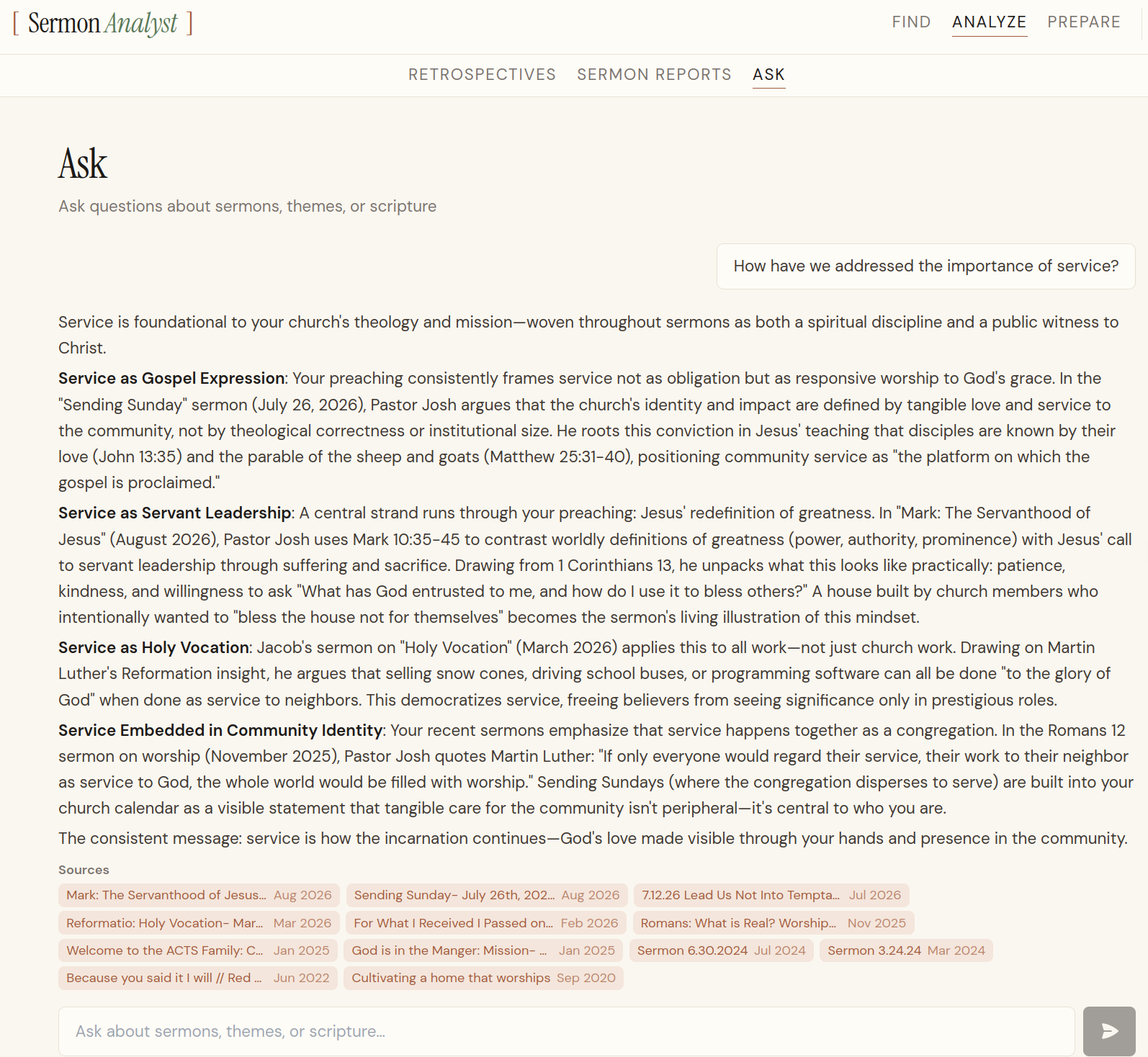
Ask questions of your archive.

For your congregation

Something for your congregation, too.

Sermon notes for the newsletter every week, and a searchable listing of every sermon you've preached for your church website.

This Week's Message

Pastor Josh opened our new series on the Gospel of Mark by zeroing in on a deceptively simple idea: the word "gospel" literally means good news. Mark's Gospel announces that the Messiah Israel had been waiting centuries for had finally arrived — and chapter 1 wastes no time showing what that looks like in practice. The leper story is the heart of it: Jesus reaches out and makes clean the one person no one would go near, restoring not just his body but his place in community.

For Reflection

The gospel is more than one note. Pastor Josh pointed out that Jesus rarely led with "I'm going to die for your sins" — he met people at their specific point of need. What facet of the good news do you most need to hear right now — and is there one you've been ignoring?

Jesus touches the outcast. The leper wasn't just sick; he was cut off from family, worship, and community. Jesus reached across that line when no one else would. Is there someone in your life — or some version of yourself — that you've quietly assumed is too far outside the circle for Jesus to reach?

How It Works

Give us your sermon feed. We’ll handle the rest.

There is nothing to upload or install. Paste the URL of your podcast feed or YouTube channel and Sermon Analyst does the rest: the last year of your archive is searchable in a day or two, and your first Sermon Review arrives within days. After that, each new sermon is picked up automatically, the review lands in your inbox, and the archive keeps itself current.

Every sermon is transcribed along the way, and the transcripts stay searchable. Look up a phrase, a passage, or a name and you’ll get the messages it turned up in — and the transcript, to read back what you actually said.

Everything it produces is grounded in work you’ve already done, and offered as an input to your existing process — nothing more. Your sermons are yours, and they are never used to train AI models.

Early Access

Interested?

Sermon Analyst is in early access with a small group of churches and open to new registration requests.

It’s built by a Christian software engineer in Austin, together with a handful of local churches. The goal is to serve pastors and help them be more effective — not to force AI into a sacred space.

Sign up for early access